February 1st, 2023 by ParadigmSI
Implementing a Business Continuity Management Program
1. Establish the BCM Ownership.
2. Align BCM Program to organizational Strategic Goals.
3. Develop the BCM Policy – Standards & Guidelines
In many cases the BCM policy and approaches are driven by standardization bodies along with local, regional, industry-imposed requirements. Codes of practice and specifications are defined by relevant international standards such as ISO 27001 – specification for an ISMS, an Information Security, Management System, and ISO 22301 – Societal security – Business Continuity Management Systems Requirements.
ISO 22301 is the leading global standard for Business Continuity Management.
The focus of ISO 22301 is to ensure continuity of business delivery of products and services after occurrence of disruptive events (e.g., natural disasters, man-made disasters, etc.). This is done by finding out business continuity priorities (through business impact analysis), what potential disruptive events can affect business operations (through risk assessment), defining what needs to be done to prevent such events from happening, and then defining how to recover minimal and normal operations in the shortest time possible (i.e., risk mitigation or risk treatment). Therefore, the main philosophy of ISO 22301 is based on analyzing impacts and managing risks: find out which activities are more important and which risks can affect them, and then systematically treat those risks. 1
Said another way, BCM is an: Holistic management process that identifies potential impacts that threaten an organization with associated risk, and provides a framework for building resiliency with the capability for an effective response which safeguards the interests of its key stakeholders, reputation, brand and value creating activities. 2
As such, the basis for building an effective business continuity management program consists of an understanding of the following primary elements:
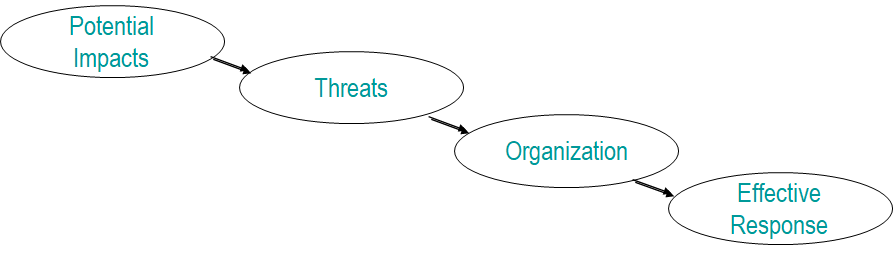
> Potential Impacts are developed from the Business Impact Analysis (BIA).
> Threats are developed from the Risk Assessment (RA) by identifying potential hazards with the highest probability, impact and vulnerability.
> The BCM view of the Organization as distinct named Critical Functions, locations, dependencies and technology requirements is determined from the Business Impact Analysis (BIA)
> An Effective Response is developed by focusing on recovery strategies for each of the organization’s critical functions with a recovery plan that attains a defined Maximum Allowable Outage (MAO) value for each.
Your organization may require adherence to several industry standards. Select the BCM and industry-specific standards and guidelines to be included in scope of your BCM program and policy. The BCM process will need to address each of the above elements in order to implement an effective Business Continuity Management program.
– NFPA 1600/1660 https://www.nfpa.org/codes-and-standards/all-codes-and-standards/list-of-codes-and-standards/detail?code=1600; https://www.nfpa.org/codes-and-standards/all-codes-and-standards/list-of-codes-and-standards/detail?code=1660
– NIMS https://www.fema.gov/emergency-managers/nims
– ISO 22301 https://www.nqa.com/medialibraries/NQA/NQA-Media-Library/PDFs/NQA-ISO-22301-Implementation-Guide.pdf
– FFIEC https://ithandbook.ffiec.gov/it-booklets/business-continuity-management.aspx
– NCUA https://ncua.gov/regulation-supervision/letters-credit-unions-other-guidance/ffiec-release-updated-business-continuity-planning-examination-handbook
For more information about how to better prepare your organization with an effective Business Continuity Management System, please contact us via:
- The contact form using the link at the top of this page
- Email at PSISales@ParadigmSI.com
- Call us at 800-558-9568 ext. 300
Next up in Part 4: Determine the BCM Strategy
2 BS 25999-2:2007, 2.4
January 3rd, 2023 by ParadigmSI
Implementing a Business Continuity Management Program
In order for the BCM program itself to be resilient, we must tangibly justify and validate the BCM effort. It is often that this part of the BCM program is neglected.
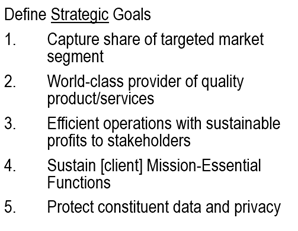
Before even attempting to define the BCM goals, does your organization have defined Strategic Goals?
For example:
Then, determine the appropriate BCM Goals which have direct traceability back to the organization’s Strategic Goals:
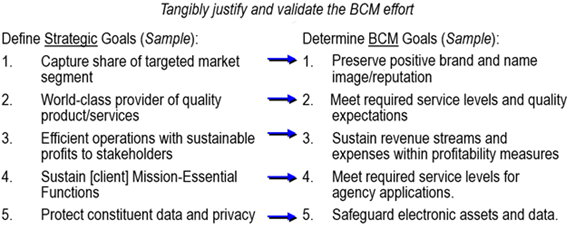
BCM Goals and Metrics should be developed and aligned back to Strategic Goals, then documented as part of the BCM Policy.
Does your organization have defined Strategic Goals that can serve as the imperative for specific and tangible BCM Program goals?
For more information about how to better prepare your organization with an effective Business Continuity Management System and development of BCM Strategic Goals, please contact us via:
- The contact form using the link at the top of this page
- Email at PSISales@ParadigmSI.com
- Call us at 800-558-9568 ext. 300
Coming next month in Part 3: Develop the BCM Policy – Standards & Guidelines
December 19th, 2022 by ParadigmSI
Cybersecurity is a critical part of business continuity management because it helps protect an organization’s information and systems from security threats. A breach of cybersecurity can have significant consequences for an organization, such as the loss of sensitive data, monetary loss, and damage to the organization’s reputation. To prevent these types of disruptions, organizations must incorporate robust cybersecurity measures into their business continuity management plan.
There are several organizations and institutions that offer recommendations and best practices for information and cyber security. Some of the main ones include the National Institute of Standards and Technology (NIST), the International Organization for Standardization (ISO), the Center for Internet Security (CIS), and the SANS Institute.
Here are some examples of recommendations and best practices for information security and cyber security from NIST, ISO, CIS, and SANS:
NIST recommends implementing strong password policies, regularly patching and updating software and security systems, and using encryption to protect sensitive data.
ISO recommends implementing a robust risk management program, including regular risk assessments and implementing controls to mitigate identified risks.
CIS recommends implementing a multi-layered approach to security, including both technical controls (such as firewalls and intrusion detection systems) and non-technical controls (such as employee training and incident response plans).
SANS recommends implementing a defense-in-depth strategy, which involves protecting the network and individual devices at multiple levels to reduce the likelihood and impact of a security breach.
The specific laws that require businesses to keep a degree of cyber security or resilience vary by country and jurisdiction. In the United States, for example, some of the main laws that address this issue include the Federal Information Security Management Act (FISMA), the Health Insurance Portability and Accountability Act (HIPAA), and the Payment Card Industry Data Security Standard (PCI DSS).
Here are some examples of what businesses need to do to comply with FISMA, HIPAA, and PCI DSS on cyber and information security:
FISMA requires that federal agencies implement a range of security controls to protect their information and systems, including regular risk assessments, training for employees, and incident response plans.
HIPAA requires that covered entities, such as healthcare providers and insurers, implement technical, physical, and administrative safeguards to protect patient health information. This includes implementing access controls, regular risk assessments, and training for employees.
PCI DSS requires that businesses that accept credit card payments implement a range of security controls to protect cardholder data, such as using encryption, implementing firewalls, and regularly testing security systems.
In general, however, most businesses are expected to take reasonable steps to protect their sensitive data and systems from cyber threats, such as implementing strong password policies, regularly updating software and security systems, and training employees on how to identify and report potential security threats. It’s also important for businesses to have a plan for responding to and recovering from a security breach, to minimize the damage and disruption caused by such an incident.
All-in-all, there are many organizations and institutions that offer recommendations and best practices for information security and cyber security, and there are also various laws and regulations that require businesses to keep a given level of security to protect sensitive data and systems. It’s important for businesses to be aware of these requirements and recommendations, and to implement controls and measures to protect themselves against cyber threats. By following cybersecurity recommendations and best practices, organizations can reduce the risk of a cybersecurity breach and ensure the ongoing availability of their systems and data. This will help organizations keep their overall resilience and ensure their ability to continue working in the face of potential disruptions.
For more information about how to better prepare your organization against cyber-related threats with an effective Business Continuity Management System, please contact us via:
- The contact form using the link at the top of this page
- Email at PSISales@ParadigmSI.com
- Call us at 800-558-9568 ext. 300
December 6th, 2022 by ParadigmSI
The purpose of Business Continuity Management (BCM) is to attain comprehensive operational continuity (ability to continue critical operations during a disruption) and resilience (planning, preparedness and protection over the long-term.)
ref: https://www.iso.org/obp/ui/#iso:std:iso:22300:ed-3:v1:en
In today’s current environment, the global economy is shifting and evolving more now than ever. Geo-political events are disrupting supply chains. Staffing levels and unique staffing approaches are being tested from the COVID-19 pandemic. Infrastructure is becoming more vulnerable with ransomware and other exploits. IT requirements are evolving with the progression of cloud-based systems and the advent of 5G. It will be important that organizations big and small protect themselves from a variety of potential disasters, which will enable them to not only grow but to become sustainable.
What are the drivers for implementation of a BCM program?
The impetus for BCM can stem from external forces such as regulatory requirements (FFIEC or NCUA for financial institutions, etc.) and legal and fiduciary considerations (Sarbanes-Oxley.) Just as well, the drivers for BCM can come from internal factors and stakeholder requirements regarding preservation of the general sustainability and growth of the organization.
Where to begin?
– Establish the BCM Ownership.
To establish ownership and drive the BCM principles throughout the organization, a BCM strategy must be created and approved by the governing board. Ownership must reside at this level as the board owns the overall resilience of the organization, where the CEO and CFO must personally attest to the validity of the data being reported. The BCM Ownership must drive and define the BCM policy in a top-down approach. BCM is difficult to impossible to implement at the grass-roots level.
The BCM Leadership Team will typically include:
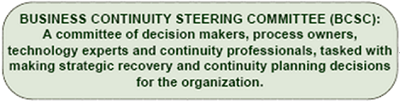
– The Business Continuity Steering Committee (BCSC) will be responsible to establish the BCM Policy. The BCSC will provide the appropriate level of authority on those areas of the organization that will most likely be involved with Business Continuity execution.
> At least one Executive, one Senior Management representative, and then what ever level of management is deemed appropriate to represent the full operational components of the organization.
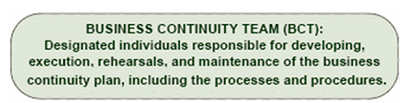
– The Business Continuity Team (BCT) will be responsible to develop and maintain the Business Continuity Plans consistent with the BCM Policy.
> Line-of-Business Leaders, Site Leaders, Program Owners.
Per the ISO BCM standard, persons in top management and other relevant management roles throughout the organization shall demonstrate leadership with respect to the BCMS via demonstration of the following activities:
> Ensuring that policies and objectives are established and communicated for the business continuity management system, which are compatible with the strategic direction of the organization, promote continual improvement, and ensure that the BCMS achieves its intended outcome(s).
> Ensuring the integration of the business continuity management system requirements into the organization’s business processes with: allocation of resources needed for the business continuity management system, communication of the BCMS requirements to organizational staff and stakeholders, directing and supporting persons to contribute to the effectiveness of the BCMS, establishing roles, responsibilities, and competencies for business continuity management, and appointing one or more persons to be responsible for the BCMS with the appropriate authority/competencies to be accountable for the implementation and maintenance of the BCMS as well as supporting other relevant management roles to demonstrate their leadership and commitment as it applies to their areas of responsibility.
Top management shall ensure the parameters and support for the BCMS are communicated within the organization by creating or updating the BCM Policy Document to include:
> Documentation of the Process and Methodology approaches for conducting the organizational BIA and Risk Assessment,
> Documentation of the Process and Methodology approaches for selection of business continuity strategies to protect the critical functions, assets and stakeholders to the organization.
> Defining the criteria for accepting risks and the acceptable levels of risk,
> Actively engaging in exercising and testing,
> Ensuring that internal audits of the BCMS are conducted,
> Conducting management reviews of the BCMS, and
> Demonstrating its commitment to continual improvement.
For more information about how to better prepare your organization with an effective Business Continuity Management System, please contact us via:
- The contact form using the link at the top of this page
- Email at PSISales@ParadigmSI.com
- Call us at 800-558-9568 ext. 300
Coming next month in Part 2: Align BCM to Strategic Goals
February 13th, 2022 by ParadigmSI
The recent executive order from the White House requires that all Federal Information Systems should meet or exceed specific standards and requirements for cybersecurity. Do your critical cloud-service solutions meet these modernized cybersecurity requirements?
The Federal Government is moving towards adoption of security best practices towards a “Zero Trust Architecture” which will accelerate movement to secure cloud services, including Software as a Service (SaaS), Infrastructure as a Service (IaaS), and Platform as a Service (PaaS).
Among these detailed requirements include standards, procedures, or criteria regarding encryption for data and establishment of multi-factor, risk-based authentication and conditional access across the enterprise.
What is your level of confidence that your organization can meet these modernized standards and could successfully prevent or recover from a security breach?
BC/DR planning tools can assist you and provide an effective foundation to build, plan, document, test, train, mature and continuously improve your organizational resiliency.
For more information about how to better prepare your organization with effective BC/DR Planning tools, or to schedule a tabletop exercise with our Certified Business Continuity Professionals, please contact us via:
- The contact form using the link at the top of this page
- Email at PSISales@ParadigmSI.com
- Call us at 800-558-9568 ext. 300
May 4th, 2020 by ParadigmSI
FEMA has developed a Fact Sheet regarding General Reconstitution Planning Considerations which can be used to develop and coordinate a plan to resume operations. Some of the content includes how organizations should assess the status of personnel, assets and facilities, pandemic planning mitigation measures, as well as financial and insurance considerations.
************************************************
FEMA FACT SHEET
Reconstitution During the COVID-19 Pandemic
In these uncertain times, organizations across the nation are grappling with when and how to resume operations while protecting the well-being and safety of their employees and communities. Many organizations will be returning to a new normal and are asking: When is it safe to bring people back? Do we need to modify how we operate? How do we keep our employees, customers and community safe? How do we maintain a safe and sanitary environment?
An organization may need to adapt and adopt new processes, address physical and psychological impacts to personnel, recover records and files, reestablish communications and IT equipment, or acquire specialized equipment to regain full functionality. Planning for reconstitution requires expertise and coordination from the entire organization and coordination with partners and stakeholders throughout the community.
This fact sheet builds upon the White House guidelines for Opening Up America Again by providing further reconstitution planning recommendations for state, local, tribal, territorial and private sector stakeholders.
General Reconstitution Planning Considerations
Identifying reconstitution considerations assists organizations to develop and coordinate a plan to resume operations. Organizations should determine how to assess the status of personnel, assets and facilities. Organizations should:
Begin now by developing a plan and procedures for how operations will be resumed. Organizations may need to consider a time-phased approach to prepare a facility to be reoccupied. Offices, functions and returning personnel may need to be prioritized or work in staggered shifts.
Communicate with employees and inform them of the process for returning to work. Consider providing online training and guidance for employees before returning.
Coordinate with partners and stakeholders. Determine what methods will be used to inform employees, customers, vendors and stakeholders that operations are being resumed.
Identify and implement additional facility maintenance tasks necessary to safely reopen closed buildings.
Address physical and psychological impacts to personnel through employee and family support plans and other human resource measures.
Develop an after-action report/improvement plan to note lessons learned and improve plans.
FEMA’s National Continuity Programs offers additional continuity of operations and reconstitution planning guidance and resources, including:
Refer to:
COVID-19 Pandemic Planning Considerations
Organizations should abide by emergency orders, applicable statutes, and public health guidelines and prioritize employee and community safety and well-being. Refer to the Centers for Disease Control and Prevention (CDC) for COVID-19 guidance and protective measures.
Measures an organization may need to consider include:
Prepare for a resurgence or additional “waves” of the virus and identify mitigation measures.
Continue utilization of telework and other workforce flexibilities. Telework.gov provides telework guidance and resources for the Federal government and may be helpful to others.
Incorporate social distancing measures, including limiting building capacities, staggering shifts, closing common areas, rotating “office days” for shared offices, installing physical barriers, and limiting non-essential travel.
Allow high-risk/vulnerable individuals additional flexibility or continue isolation without repercussions.
Acquire cleaning supplies, masks/face coverings and gloves, and implement personal protective policies or measures (handwashing, hand sanitizer, etc.) to limit the spread of the virus and protect employees and customers.
Conduct health screenings to monitor employee wellness and prevent further infections and develop or revise human resource policies to detail processes for sick employees or family members, as well as those exposed to the virus or showing symptoms.
Intensify cleaning, sanitizing, disinfection and ventilation activities according to CDC and the Occupational Safety and Health Administration (OSHA) guidance:
CDC: www.cdc.gov/coronavirus/2019-ncov/community/organizations/cleaning-disinfection.html
OSHA: www.osha.gov/SLTC/covid-19
State, Local, Tribal and Territorial (SLTT) Government Considerations
SLTT and insular area governments play a critical role in involving the whole community in preparing for the resumption of governmental and private sector functions and recovering from a health and economic crisis. The White House Opening Up America Again guidelines establish three phases and gating guidelines to assist SLTT governments in their decision-making processes. SLTT governments will need to continue to coordinate with businesses, industry and critical infrastructure owners and operators to determine resource requirements and how supply chain disruptions affect resource management efforts. Additional considerations include:
Public health infrastructure: Plan for continued virus testing, reporting, and contact tracing efforts and monitoring public health and healthcare system(s) capacity for a resurgence.
Schools: Develop plans and policies for training and resource support for intermittent E-learning. The U.S. Department of Education offers COVID-19 guidance and resources: www.ed.gov/coronavirus
Public Transportation: Develop plans for ensuring public health while providing public transportation. Refer to the U.S. Department of Transportation COVID-19 resource page: www.transportation.gov/coronavirus
Critical Infrastructure: The Department of Homeland Security (DHS) Cybersecurity and Infrastructure Security Agency (CISA) offers guidance and resources for critical infrastructure owners and operators: www.cisa.gov/coronavirus
Intergovernmental Coordination: Coordinate across all branches of government (legislative, judicial, executive) and with neighboring jurisdictions to discuss planning, response and mitigation efforts.
Disaster Financial Management: Refer to FEMA’s “Disaster Financial Management Guide” for state and local jurisdictions: www.fema.gov/media-library/assets/documents/187126
Private Sector Considerations
Restarting a business may be challenging, and an organization’s reconstitution plan may need to balance health and financial concerns. Customers will need to feel safe enough to venture out. Organizations will be more likely to succeed if they take serious preventive measures and can demonstrate that they are safe. Organizations should keep up to date with federal, state and local mitigation recommendations, and clearly communicate these updates and measures with employees and stakeholders. Additional private sector considerations include:
Consider applying for a disaster loan. The Small Business Administration (SBA) offers disaster assistance in the form of low-interest loans to businesses, renters, and homeowners: www.sba.gov/disaster-assistance/coronavirus-covid-19.
Contact customers, vendors and suppliers to determine demand or potential supply issues.
Review insurance policies to determine eligibility for coverage of business interruption or loss.
Establish online commerce platforms, train staff to operate in an e-commerce environment, and adjust business models for a new economy.
Additional Resources on COVID-19
Questions to Consider When Reconstituting Operations
| People |
- Who will be responsible for COVID-19 issues and how they impact our workplace(s)?
- Are our human resources policies and processes consistent with public health recommendations and federal/state statutes?
- Have we established a priority order of return?
- Do new policies regarding sick leave, scheduling, control measures, etc. need to be established and/or continued?
- How do we determine employee status and their availability to return?
- Have employees been exposed to COVID-19?
- How can we protect employees?
- Can alternate work arrangements be established for at-risk employees?
- Will there be new requirements for returning to work (e.g., employees must be symptom-free)?
- How will hiring be conducted?
- Have we accounted for a possible resurgence of COVID-19 within our workforce and the community?
- Do we have a plan if stricter social distancing policies are enacted?
- Can training be conducted virtually, including new hire and new health and safety requirements?
- What is the status of childcare and dependent care services to support employees returning to work?
|
| Messaging/Communications |
- How and what are we messaging/communicating with our employees, stakeholders, vendors, and customers?
- What considerations need to be communicated to employees prior to reopening?
- Health and safety measures?
- Change in schedule or shifts?
- Employee status?
- Priority/phased opening?
- Requirements for returning to work?
- How frequently will messages be disseminated?
- What should employees expect when they return to work?
- How would we conduct employee accountability?
- What should customers/stakeholders expect when we reopen?
- Have we coordinated with contractors or vendors about their plans to reopen or how our reopening will impact them?
|
| Facilities |
- Who is responsible for ensuring our facilities meet the necessary safety and health guidelines to reopen?
- Have we established a priority order for opening multiple facilities or business locations?
- Have we identified the health and safety requirements outlined by CDC, HHS, OSHA, etc. specific to our organization?
- Can our facilities accommodate any necessary social distancing requirements?
- What health and safety assessments need to occur before we can re-enter our primary location?
- Will this require contract or vendor support?
- Can any necessary facility repairs, updates, or cleaning occur now (during social distancing measures) to prepare for reopening?
- How can we reduce our employee exposure to COVID-19?
- Have we created a plan to clean and disinfect our frequently touched objects and surfaces per EPA’s criteria for use against COVID-19?
|
| Resources/Logistics |
- Have we determined which portions, if any, of applicable statutes apply to our organization (e.g. CARES Act, etc.)?
- If required or necessary for infection control, do we have the necessary cleaning supplies and personal protective equipment (PPE) for our employees (e.g., masks, gloves, face shields, etc.)?
- Has an accounting been done to determine what resources we have on hand, and what resources are required to reopen?
- Is our supply chain able to accommodate supporting our logistical requirements in preparation for reopening?
|
https://www.fema.gov/news-release/2020/04/30/planning-considerations-organizations-reconstituting-operations-during-covid
************************************************
For more detailed information about how to better prepare your organization with an All Hazards Risk Assessment, effective BC/DR Planning tools, or to schedule a tabletop exercise with our Certified Business Continuity Professionals, please contact us via:
- The contact form using the link at the top of this page
- Email at PSISales@ParadigmSI.com
- For more information, call us at 800-558-9568 ext. 300
- To speak with a Sales Representative about Business Continuity Planning Consulting or Business Continuity Software, please call:814-330-2560